Sunday, January 24, 2016

Two Cents; Issue 1; Outdoor Research's Furio


-Outdoor Research's Furio hard-shell provides great all around protection and is tailor made for alpine climbing. 


It's Job

I had heard that for each person there was a small handful of jackets that would be perfect, and do what they want need it to do. Mine needed to be water proof, of moderate weight, durable and work with the gear I already had.  That meant I was looking for a Gore-Tex alpine shell, not a cheep market to be in. However, as part of my plan to acquire as much gear as possible before my NOLS trip, finding the right shell was paramount.


Brand Loyalty

Something, I'd heard of, but never subscribed to.  However, when the realization hit me that this could be something that I would have for decades it did sway more decision in which company to buy from. It wasn't going to be a deal breaker, but it was a consideration. Owning a hard-shell from an American company also was important to me. Outdoor Research met all of those criteria.

I now own three jackets from them.


The Pro's

  • Two types of Gore-Tex
    • More durability where it is needed
  • Water proof zippers without storm flaps
  • Two Way pit zip's from the bottom of the garment 
    • For easy use around harnesses
  • Helmet compatible hood
    • Three way adjustable for when the weather gets nasty
  • Drawstring around the waist 
    • Adjustable on both sides
  • Pockets perfectly placed for designed use

The Con's

  • Main zipper hard to start 
  • Garment length is 2 inches short 


Worth Mentioning

While there are a couple of pockets that are placed in weird places, my biggest complaint is the length. When standing the bottom falls an inch and a half over the top of my pants. But it's not long enough for my tastes. One possible reason for OR's choice to make the length short could be it is designed to slide beneath a harness, that's my best guess.  


In Conclusion 

The Furio is a wonderful light weight alpine hard-shell that keeps winter at bay and the rain away in the summer. It walks away with a 8/10. It does everything it said it would and more, and only receives an 8 because of the length of the garment. This jacket will stay in my arsenal for many years to come.


Go, No Go;

This jacket receives a go form me. It is a great piece: not too heavy for summer use, but beefy enough to use in the winter.  Two thumbs up.


Two Cents 

The two cents articles will be gear reviews from my inventory.

Enjoy the articles as they are written about what I consider to be my family; my gear.


K


Sunday, January 10, 2016

Finding Yeti; The Universe of the Softshell Jacket


  • The jacket that polishes off the outfit, and causes the most headache.


Some Clarification

For the purpose of simplicity, we will define a soft-shell as wind resistant. It creates the wall of the micro-environment when water is not present. Varying layers of insulation for different seasons and pursuits, this is quickly becoming the layer with the most variety on the market. The membrane of a hard-shell typically has a weave of 1:1, whereas a generic soft-shell normally has a 2:1 weave. A soft-shell is heavier than a wind layer, but not as waterproof as a hard shell. Winter hard-shells will have a water resistant coating, but are in no way waterproof. A summer shell will have no insulation but will be windproof and have some insulation. We will get through this one topic at a time.


The Winter Soft-shell

A winter soft-shell is characterized by a heavy fleece and a thick, burly fabric. Designed to shed snow, breath, and provide some warmth, but also being slim enough to fit beneath the hard-shell of choice. One will trade warmth for breathability depending on the density of the fleece. Normally the cuffs will be long so they sit over a pair of light weight gloves. Depending on how burly the outer layer is depends on how water resistant the garment will be. This jacket is best suited for mildly cold winter days where high aerobic activities take place. Look for a garment that appears to be too thin and that will probably be perfect. It should function as a mid-layer and an outer shell on the days where the skies are gray but you still went out to play.


The Summer Soft-shell

A soft-shell for the summer is designed to keep the wearer dry and keep the wind out. For the days when it doesn't feel like summer and will be windy. Having a layer that is light weight, provides a little warmth, and keeps the wind out would be worth its weight in gold. Coats like this aren't water resistant. Don't buy a shell like this and expect it to shed water. This is a very light mid layer. Very light as in you won't feel like you aren't wearing a coat, light. It's sole purpose is to keep the wind out. While it can be used as a layer during the winter, its not heavy enough to provide much warmth. 


The Spectrum 

Those highlighted have been close to the two extremes of the soft-shell universe. There are jackets between those two examples and further in each direction. Like anything else in the gear world, it's all about what works best for you. Be careful when you go hunting for a soft-shell as there are many shells out there that claim to be super duty soft-shells, expedition soft-shells. Shells like this will look and feel like a hard shell, with many of the same bells and whistles, stay away from those. If you picture yourself in environments like this, get a hard-shell. One can not afford to spend $200 plus on a soft-shell to find out it doesn't work. My recommendation is that if it costs  more then $180, its not what you want. Think of the soft-shell as a bulky mid-layer that can be used on days where the moisture won't be a big issue.


Oddities

Every family has them. When you look at a soft-shell and can't figure out what it is, that's an oddity.
Mountain Hardwear's AirShield fleece jacket for example. Pit zips like a hard-shell, soft-shell fabric where the weather can get to it and fleece everywhere else. The great equalizer is the 'Wind Stopper'. A Gore product that is wind proof but is not water proof. This is just one of the handful of examples that don't really have a category so they were lumped into the 'soft-shell' group. This can be a very cool coat to have but doesn't have a solid foothold in the average collection of equipment simply because they are so specialized that they tend to be just 'okay' in the normal use and abuse they take while in the mountains.


It's Not the Same

Why not just get a fleece, I hear you ask. A fleece is inexpensive, light weight, and does well when it is wet. Don't be fooled, fleece is not wind proof. It feels like it, but it's not. It does cut the wind substantially, but if you wore just a fleece with no base layer you will feel the wind. The other thing to consider is that a soft-shell will be water resistant. Fleece will be okay when it is wet, true, but life is miserable when you are soaked. Most soft-shells also come with a hood, which can be just the extra warmth that you need to take the level from bearable to perfect. You could look at a medium to heavy soft-shell as a fleece on steroids: normally with a hood, a drawstring, and adjustable cuffs. If you are looking for a good fall layer, then a soft-shell is a great option. 


Final Thoughts

If you are serious about being outside you will probably end up owning 3 or more soft-shells, some are strong in one seasons, and weak in another, that is okay. Where one could get into hot water is when you buy a soft-shell without doing the research and now you have a shell that does the same thing as an existing piece. As you peruse through the many options that you have before you be sure to ask until you understand what it is you are looking at. Also keep in mind that the jacket should work with the rest of your gear that you have, harnesses and pack straps to give a view examples. 


Enjoy.


K


Monday, January 4, 2016

The Shield; What is a Hardshell.


  • Finding a good hard-shell is crucial if you plan on being outside all year around. A person's shell tells you a lot about the person's hopes and dreams as they write their outdoor resume.


The Easy Part

A hard-shell is a water proof and wind proof layer. Designed for alpine endeavors with ease of use in mind. It creates the boundary for the micro-atmosphere that sits between the person's skin and the elements .


It's More Then A Raincoat

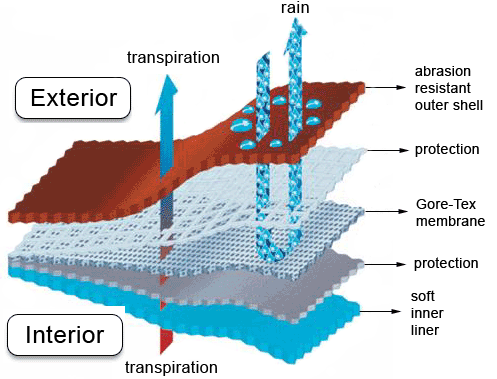
Yes, a rain jacket is water proof, yes a rain coat will have some wind proof properties; however, rain coats are designed to simply keep the rain out. A salesmen will never sell you a raincoat on its durability or its versatility in an alpine pursuits. That is what a hard-shell will do for you. Most rain coats use a 2 layer system to keep the elements out. Hard-shells use a three layer system to keep water and wind out, and also remove body head and moisture.


What is Gore-Tex

Gore-Tex is a name brand water proof fabric that companies use to make their garments water proof and wind proof. Gore runs ALL of their products through a battery of tests before they give the go ahead for the company to produce the garment for public sale. If a product has 'Gore-Tex' on it, then product is guaranteed to keep the wearer dry.


A Hard-shell That is NOT Gore-Tex

That means it is the company's own 3 layer take off on Gore-Tex. It's not necessarily a bad thing. However, it is unheard of for an outdoor company to make a high end hard-shell that is not Gore-Tex. Because Gore sets such high standards, it is expensive for companies to go through the process of getting it 'Gore' approved. Most companies have their own version of a 3 layer system. There is a reason that serious hard-shells are made of Gore-Tex, it's because it works. 


If You Like to Lift Weights, Lift Weights, If you Like to Run, Run

A hard-shell is a big investment for the average person who spends time outdoors. As I covered in Choosing the Right Winter Shell, a hard-shell can cost anywhere from $180-$700. Those are scary numbers.  It all comes down to how often you're up in the hills, and what you do when you are there. If you enjoy short day hikes in the summer, a raincoat is the way to go. If you outside for multi-day trips miles away from shelter, a light hard-shell would be just about perfect. It boils down to what you want to do outside. Just remember that your equipment should always enhance your experiences in the mountains. If what you choose fits that criteria then it was money well spent. 


K